


Zero waste lifestyle: how to reduce your ecological footprint

What is zero waste?
The zero waste strategy is very simple: reduce the amount of waste we produce annually by adopting responsible and minimalist lifestyle habits. Live better, consume less!
It is sad to learn that Canadians are the “champions” in terms of waste production. In fact, the average Canadian produces nearly 720 kg of waste per year: the inhabitants of Nova Scotia still come first in the country with 386 kg of waste annually and those of Alberta come last, with 1,007 kg per year.
Less than a third of waste is redistributed in the corresponding facilities, so it is sent to waste treatment plants. That said, these factories are very expensive and not all cities can afford them. So what happens to our waste? They are simply deposited in open air landfills where their toxic fumes can circulate freely. This is saying something, existing compost facilities in Canada are only used at 38% of their capacity and could contain 1.6 million tonnes more!1
It is to make a change in the world for our present and for our future that the zero waste strategy was created. On the one hand, the strategy suggests the modification of waste storage processes and on the other hand, the modification of the transformation processes. The zero waste approach therefore offers alternative waste management2.
The zero waste strategy has been proven to be beneficial for the planet, without requiring much more time in our daily lives, nor costing us more. You just have to make the right decisions, prepare in advance and go for it!
Why do we hear a lot about zero waste?
We hear so much about zero waste because the ecological cause has never been so close to the hearts of the population. The committed scientists, activists and famous personalities of this world are clear: our planet is in danger. Many retort: the planet is strong, it will hold up. But of course! But at what cost? More vegetation? More pure water? A sun so hot that it prevents us from setting foot outside in the afternoon? The cry of alarm is serious, very serious. We must stop denigrating science and turning a blind eye. This is all very serious.
Every day, humanity produces billions of tons of waste, which leads to global warming and the poisoning of our lands and waters. Humanity, but also vegetation and animals, are already amply paying the price for past mistakes. If the deterioration of our planet is not controlled, the consequences will be catastrophic in the not too distant future.
What are the effects of zero waste for the environment?
We have already reached the milestone of +2°C of global warming, 32 years before the previously estimated date (2050). “Beyond +2°C, we will begin to exit the current climate system and, at +4°C, we enter an unknown model, declared climatologist Hervé Le Treut in December 2015.
According to authorities on the subject, it is not too late to stabilize climate degradation, but it is important to act quickly, and above all, to act now.
The zero waste strategy is THE step that consumers can take to save the planet. Indeed, an ecological and minimalist lifestyle could stabilize the decline of this planet which has supported us for so long. But how?
Let’s take a simple example: plastic bags. Did you know that their production uses petroleum products, water, energy and emits greenhouse gases which are, among other things, responsible for global warming? In addition, the end of the life of plastic bags is very harmful to the environment since it is not profitable to recycle them. Hey yes! Plastic bags are too light, they move here and there with the wind, in cities as much as in nature and recycling them would consume more resources than they would return.3. As a result, 80% of plastic bags are neither recycled nor reused. By opting for reusable bags, we greatly reduce our ecological impact. The zero waste strategy brings these types of environmental benefits: less waste = less energy/water/gas/oil used.
It is easy to practice hundreds of small actions towards a greener world: saying no to plastic bags is one of them.
How to start zero waste?
Frenchwoman Béa Johnson, internationally recognized author and activist, proposes the following principles: refuse, reduce, reuse, recycle and compost
1- Refuse: a Zero Waste lifestyle always begins with decision-making: we must learn to say yes to the environment and no to the traders who constantly offer us circulars, paper invoices, over-packaged products in grocery stores and plastic bags. We must accept the fact that some people around us will raise eyebrows at our new way of life. You also have to prepare, because a transitional phase is mandatory: use what you already have at home before jumping headlong into purchases, with a view to an ecological shift. For example, I have a lot of plastic “tupperware” dishes. I know they're not ideal in environmental terms, but throwing them away would be worse. So I'm going to wear them out before swapping for the window and/or the cotton bags.
2- Reduce: a Zero Waste lifestyle involves a major reduction in expenses and uses. The right question will always remain: do I really need it? This is THE question we must ask ourselves, constantly. A good idea would be to do a major cleaning to see what we keep, what we can donate and what we can reuse. It takes time, but we are so proud once it’s done! And don’t forget that minimalism rhymes with ease.
3- Reuse: a Zero Waste lifestyle encourages the reuse of goods. When I was little, my father always used our holey cardigans as hand towels in his garage and we always donated clothes that had become too small to thrift stores. Without even knowing it, my parents were subtly teaching me the zero waste strategy. Over the years, I have continued these little habits, particularly when it comes to giving clothes that I no longer wear to thrift stores...and while I'm at it, why not take the opportunity to take a look? Thrift stores are full of little finds and represent one more step towards the zero waste strategy.
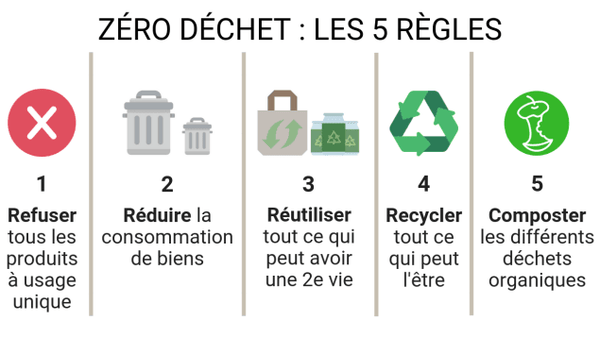
4- Recycle: a “must” of the Zero Waste lifestyle! Recycling consists of reintroducing waste into a production cycle to produce new products. This is probably the step that we all take, since awareness campaigns began in the early 1980s in several Canadian cities and even earlier in Alberta, where recycling regulations for plastic soft drink and juice containers were put in place in 1972. Recycling means ensuring that certain materials, such as cardboard, plastic, glass, porcelain, light bulbs, metal (and much more) do not end up in landfill sites.
5- Compost: the last, but not the least towards the zero waste lifestyle. Compost seems to scare many people, but there is nothing like it for a zero waste lifestyle. Once the transition phase has passed, nothing is easier. I once had a garden adjacent to my townhouse, all I had to do was open my backyard gate to toss in my compostable waste. I looked really chic in my pajamas tossing my eggshells and vegetable peelings after my morning omelette. Nevertheless, the vegetables that grew in this garden were delicious, and fertilized with 100% natural and 100% free compost! About vegetable peelings, they can be very easily reused in cooking to avoid throwing them away, especially if you don't have a garden. For example, you can add them to a mixture of vinegar, sugar and salt to turn them into a homemade marinade. Another good tip is to keep lemon peels in the freezer, waiting to be mixed with white vinegar: this becomes an excellent, completely natural cleaning product.
Is zero waste expensive?
After the transition phase, the zero waste lifestyle allows you to save between 20% to 40% on the final bill. For example, I encourage you to learn to wash what can be washed: diapers, cleaning pads, coffee filters, certain tissues… I even have a friend who cleans herself with a washcloth when she goes to the bathroom, she saves the paper for “number twos”. Everyone has their own method, but if it works for her, I say go!
Reuse also saves money: fabric softener sheets smell good and are effective for several uses, canned goods which, once properly cleaned, can be used as a storage container in the garage, the back of printed papers can be used to take notes, plastic bottles can be used as a bird feeder... not to mention everything that can be reused as decorative objects. So if you are at all artistic, let yourself go!
And above all, try to buy used. We thus contribute to the reduction of waste... in addition to saving significantly. Nowadays there are a multitude of websites where we can find used items and almost every city has sales pages on Facebook. Not forgetting the garage sales, which still attract thousands of people every summer.
Another interesting challenge would be to learn how to make your own makeup or cleansing products. So there we really save. Most of the ingredients can be found at the grocery store and cost next to nothing. There are plenty of sites and videos on the internet, I strongly encourage you to do your research.
Tips and Tricks
- Bring a container at the grocery store and ask the butcher to put your meat in it. This may seem awkward at first, but rest assured, your butcher will be happy to help you! Don't forget to ask the butcher to calculate the tare of your container, so as not to pay for its weight.
- Along the same lines, take your pastries, croissants or bread in a fabric bag and your dry products in bulk in glass containers.
- Buy in bulk. Indeed, buying in bulk is definitely one of the actions that will have the greatest impact on the zero waste strategy. Bulk promotes the reduction of waste, but also of unnecessary packaging. It helps reduce food waste by offering the possibility of purchasing only the quantities necessary, and thus prevents consumers from storing unnecessarily in cupboards.
- If a bulk item at the grocery store asks for a code, instead of writing it down on paper, take the code photo or write it down in a notes app on your phone. Do the same with your grocery list!
- Buy local. Food that comes from far away has had to be transported thousands of kilometers to reach our supermarkets. The environmental cost of food transportation is enormous! In addition, by buying local, we eat better, we eat fresh and we encourage our local businesses instead of encouraging multinationals.
In light of all this information, logically only one question remains: How to reduce your ecological footprint?
Starting now!
Sources
2:Wikipedia
3: http://www.vedura.fr/environnement/pollution-sac-plastique