


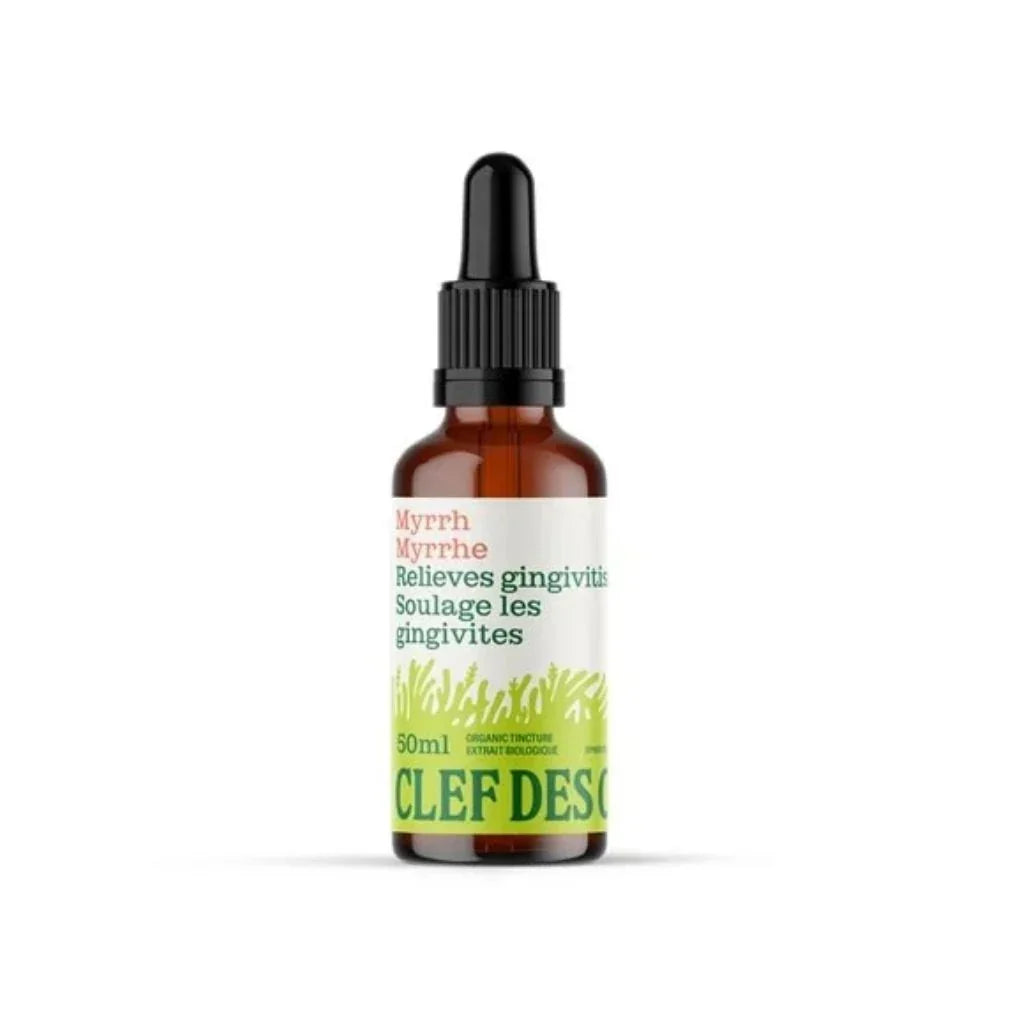
Myrrh Organic Extract
- 19.99$
23.99$- 19.99$
- Price per unit
- by
Save 4.00$
Brand :
Clef des Champs
SKU:
69702613108
Subtotal:
19.99$
★★★★★
Read our reviews (2220+)

PREPARATION
- The resin is macerated in organic alcohol
- The preparation is brewed daily for 30 days, pressed, decanted and sifted.
- No additives, colors or preservatives
- No added sugar, gluten-free, soy-free, GMO-free, non-irradiated
FORMAT
Amber glass bottle with dropper - 50 ml
INDICATIONS
Respiratory system: Asthma, chronic bronchitis, smoker's cough, shortness of breath, laryngitis, pharyngitis, tonsillitis, sinusitis
Mouth (topical use): Gingivitis, inflammation of the oral cavity (ulcer, abscess), halitosis (bad breath)
External uses: Nail, abscess, infected wound, hemorrhoid, mycosis, thrush, athlete's foot
MODE OF ACTION
An antiseptic, antifungal and bactericidal plant, myrrh contains 20 to 40% resins and up to 17% volatile oils dissolved in its resins. It works mainly via circulation, its volatile principles being quickly absorbed into the body.
Myrrh contains phenols and aldehydes which cause drying and are sanitizing when used topically. It is a very active plant that is used internally in small, spaced doses and in slightly larger or frequent doses for topical use for its antiseptic and healing properties.
FAVORABLE ASSOCIATIONS
PULMONATHE infusion in cases of upper respiratory tract infection. Drink 1 liter per day.
PLANTAIN SYRUP for sore throat, tonsillitis, laryngitis, cough. Take ½ to 1 tsp. teaspoon, 1 to 4 times a day, as needed.
SINUSITHE in capsules in cases of sinusitis. Take 1 to 3 capsules, 2 or 3 times a day.
PURIFISANG infusion in cases of fungal infection. Drink 1 liter per day.
BARDANE as an infusion or poultice in cases of nails or infected wounds. Drink 1 liter per day.
PLANTAIN as an ointment or infusion in cases of hemorrhoid or infected wound. Apply ointment generously as needed.
TRADITIONAL USES
Long considered a medicinal and sacred plant, myrrh symbolizes medicine and health and was given as a gift to the Child Jesus by one of the wise men. The Hebrews used it to anoint the tabernacle, and according to Scripture, the sacred oil that the women brought to Jesus' tomb contained myrrh, aloe, cassia, and cinnamon.
In China, it was recognized as an antispasmodic and stomachic, in Algeria it was used to clean wounds. Theophrastus and Pliny the Elder make extensive mention of the uses of myrrh as an antiseptic and antispasmodic plant.
In traditional herbalism, myrrh is used in cases of indigestion, ulcers, colds, coughs, bronchial congestion, arthritic pain, cancer, leprosy, syphilis. Myrrh is also used as a stimulant, antispasmodic and to increase menstrual flow. In topical use, it is used in cases of hemorrhoids, bed sores, wounds, abrasions, boils, bad breath and loose teeth.
CERTIFICATION
- Organic ingredient under independent control (Ecocert Canada)
- Controlled by the Conseil des appellations agroalimentaires du Québec (CAAQ)
- Manufactured according to Good Manufacturing Practices
References
1 BrinkerFrancis. Herb Contraindications and Drug Interactions. Third Edition. Sandy: Eclectic Medical Publications; 2001.
2 McGuffin Michael et al. Botanical Safety Handbook. Boca Raton: CRC Press; 1997.
3 Blumenthal, Goldberg, Brinckmann. Herbal Medicine: Expanded Commission E Monographs. Newton: Integrative Medicine Communications; 2000.
4 Barnes J., Anderson L.A., Phillison J.D.. Herbal medicines. Second Edition. London (UK): Pharmaceutical Press; 2002.
5 Winston David, Kuhn Merrily A. Herbal Therapy & Supplements. Philadelphia: Lippincott; 2000.
6 Chevalier, Andrew. Encyclopedia of medicinal plants. Montreal: Selection from Reader’s Digest, 1997.
7 Bradley Peter R. British Herbal Compendium.Volume 1. Bournemouth: BHMA; 1996.
8 Wichtl Max. Herbal Drugs and Phytopharmaceuticals. Stuttgart: Medpharm Scientific Publishers; 1994.
9 Leung Albert Y., Foster Steven. Encyclopedia of Common Natural Ingredients Used in Food, Drugs and Cosmetics, 2nd edition. New York: Wiley-Interscience Publication; 1996.
Related Products
Product title
- 19.99$
23.99$- 19.99$
- Price per unit
- by
Save 4.00$
Product title
- 19.99$
23.99$- 19.99$
- Price per unit
- by
Save 4.00$
Product title
- 19.99$
23.99$- 19.99$
- Price per unit
- by
Save 4.00$
Product title
- 19.99$
23.99$- 19.99$
- Price per unit
- by
Save 4.00$
Product title
- 19.99$
23.99$- 19.99$
- Price per unit
- by
Save 4.00$
Product title
- 19.99$
23.99$- 19.99$
- Price per unit
- by
Save 4.00$
Product title
- 19.99$
23.99$- 19.99$
- Price per unit
- by
Save 4.00$
Product title
- 19.99$
23.99$- 19.99$
- Price per unit
- by
Save 4.00$
Product title
- 19.99$
23.99$- 19.99$
- Price per unit
- by
Save 4.00$
Product title
- 19.99$
23.99$- 19.99$
- Price per unit
- by
Save 4.00$
Recently Viewed Products
Product title
- 19.99$
23.99$- 19.99$
- Price per unit
- by
Save 4.00$
Product title
- 19.99$
23.99$- 19.99$
- Price per unit
- by
Save 4.00$
Product title
- 19.99$
23.99$- 19.99$
- Price per unit
- by
Save 4.00$
Product title
- 19.99$
23.99$- 19.99$
- Price per unit
- by
Save 4.00$
Product title
- 19.99$
23.99$- 19.99$
- Price per unit
- by
Save 4.00$
Product title
- 19.99$
23.99$- 19.99$
- Price per unit
- by
Save 4.00$
Product title
- 19.99$
23.99$- 19.99$
- Price per unit
- by
Save 4.00$
Product title
- 19.99$
23.99$- 19.99$
- Price per unit
- by
Save 4.00$
Product title
- 19.99$
23.99$- 19.99$
- Price per unit
- by
Save 4.00$
Product title
- 19.99$
23.99$- 19.99$
- Price per unit
- by
Save 4.00$
- Choosing a selection causes the entire page to be updated.