


Homemade vegetable broth
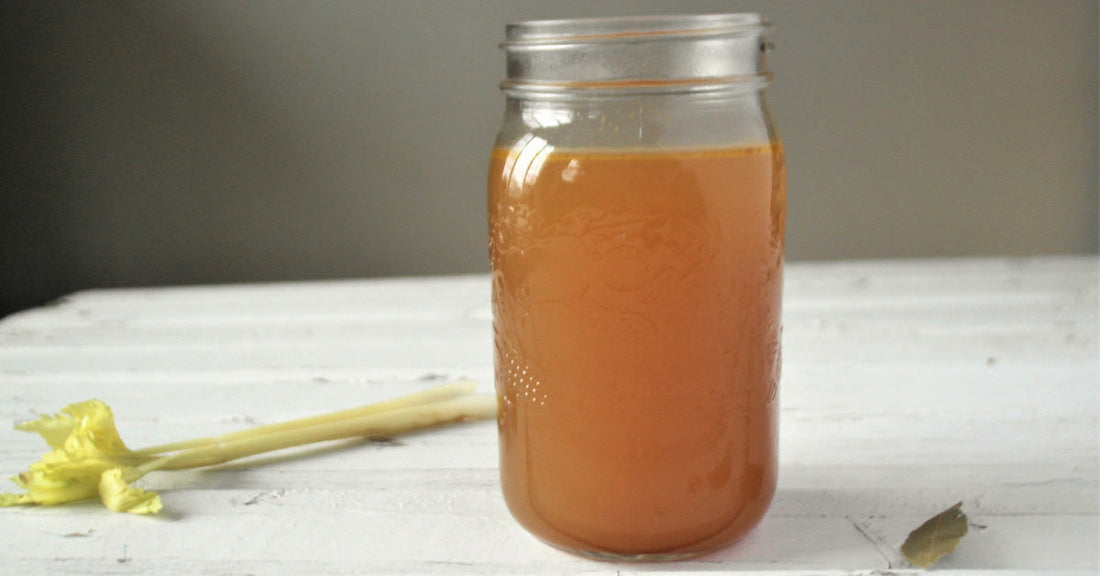
Homemade vegetable stock is easier and quicker to make than you might imagine. In addition to being able to use vegetable cuttings, homemade broth allows us to control the quantity of salt and the quality of the ingredients.
Indeed, commercial broth is generally very high in sodium and contains flavor enhancers which are undesirable.
Here is our recipe for homemade vegetable broth. You will discover which vegetables to use, which ones to avoid and our tips for getting the flavor right.
To your cauldrons!
Tips on Making Homemade Vegetable Stock
Vegetable scraps can be frozen as you go, in order to accumulate them.
Homemade vegetable broth is made up of five categories of ingredients.
- Onions and garlic : Essentials that will act as the base of the infusion, offering a generous flavor profile.
- Primary vegetables : Carrots and celery should be prioritized. These are vegetables with a familiar taste and they give a lot of flavor to the broth. Use cuttings, including stems, leaves and peels.
- Secondary vegetables : These vegetables complement the taste of the broth. We use up to half as many secondary vegetables as primary vegetables. For example, use pieces or cuttings of: squash, asparagus, kale, Swiss chard, parsnips, beans, cauliflower and fennel. Avoid using broccoli and Brussels sprouts as they will give a bitter taste to the broth.
- Herbs : Bay leaves are essential. Other herbs should be chosen carefully. Parsley and coriander can be added in large bunches, although it is preferable to choose one of the two. The flavor profile can be supplemented with a small amount of the following herbs (a choice of) chives, basil, thyme or oregano, marjoram or sage.
- Flavor enhancer : By adding a teaspoon of paste of miso, seaweed, tamari or dried tomatoes, the broth will be even tastier.
Preparation: 5 minutes
Cooking: 1h10
Servings: 12 cups
Ingredients
1 tablespoon ofcooking oil
1 yellow onion, roughly chopped
2 cloves of pressed garlic
3 cups of raw vegetables, roughly chopped (see 2. above)
1 ½ cups of secondary vegetable scraps (see 3. above)
1 handful of washed fresh parsley
5 fresh basil leaves
1 teaspoon miso paste
12 cups of cold water
Salt and pepper to taste
Approach
- In a large pot, brown the onion and garlic in the oil.
- Add the primary and secondary vegetables and sauté for 5 minutes.
- Add the spices and herbs. Continue cooking for 2 minutes.
- Add the cold water and bring to the boil.
- Cover the pot, reduce the heat to low, and simmer for 45 minutes, taking care not to stir. (To prevent the vegetables from falling apart and thickening the broth)
- Add the miso. Add salt and pepper to taste and continue cooking for another 15 minutes.
- Close the heat and filter the broth using a sieve.
- Let the broth cool to room temperature before pouring it into airtight containers.

Don't have time to make your own vegetable stock? Adopt Herbamare low sodium vegetable broth by A. Vogel! It is organic, gluten-free, non-GMO, and vegan.
About the author
Naturopaths from La Boite à Grains
Team of qualified and certified naturopaths (ND) in Gatineau in Outaouais.
Original article written by Véronique Cousineau, Naturopath
Products Recommended in This Article

Organic Laurel Leaves
- 7.49$
- 7.49$
- Price per unit
- by
-
10 g


Herbamare Low Sodium Vegetable Broth
- 4.79$
- 4.79$
- Price per unit
- by
-
8 cubes x 9.5 g
2 comments
Lyne, ça nous fait plaisir de partager!
Merci Stéphanie pour vos bons conseils ; j’ai l’habitude de faire mes propres bouillons mais avec vos précieux conseils ils seront meilleurs….